.png)
Pergola vs. Ramada: Which Shade Structure Is Best for Arizona Homes?

Your comprehensive guide to choosing the right shade structure for your backyard or front yard space.
It's one of the most common questions I get during backyard consultations:
"Should we do a pergola or a ramada?"
Most homeowners ask it thinking the answer is mostly about style. What they usually don't realize is that in Arizona, this decision is also about whether your family will actually use the space you're about to spend good money on.
I've been building outdoor living spaces in the Valley since the 1990s. I've installed hundreds of both structures, and I've had plenty of follow-up conversations years later with homeowners who were thrilled with what they chose and a few who wished they'd listened a little more carefully before deciding. This article is essentially what I tell people during those consultations, written out so you can think it through on your own terms before we ever meet.

What's the Actual Difference Between a Pergola and a Ramada?
The terms get used loosely and sometimes interchangeably, so let me clear this up.
A pergola is an open or semi-open structure. It has posts and a roof made of beams, lattice, or slats that allow light to filter through. Some have decorative cross-hatching, some have wider gaps, but the defining feature is that sunlight still reaches you underneath it. A pergola gives you filtered shade.

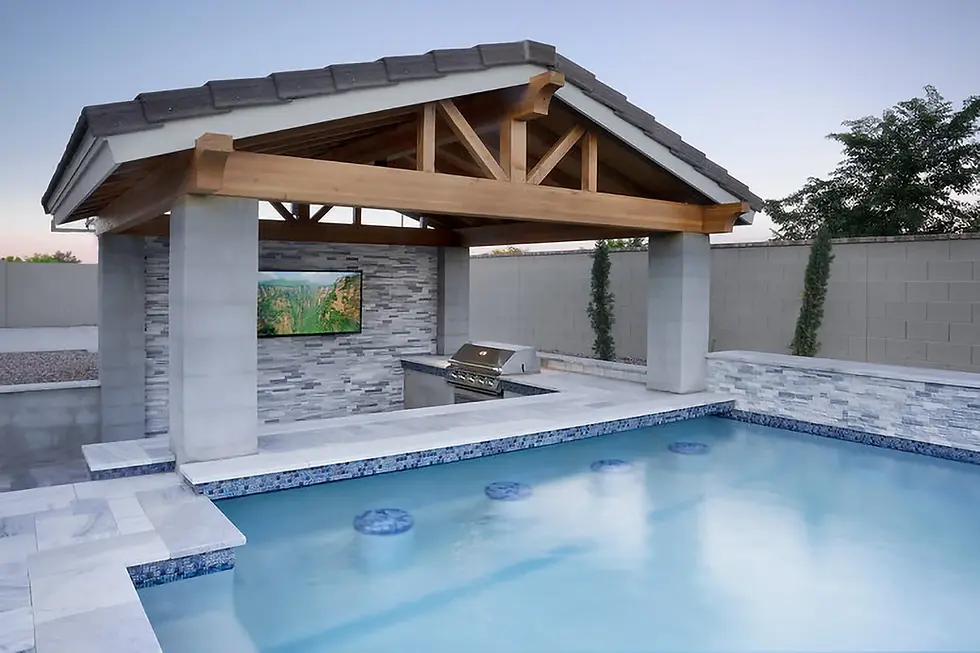
A ramada has a solid roof. Full coverage. No light filtering through, no gaps, no lattice. In Arizona, the term ramada is used broadly to describe any solid-roof shade structure, whether it's built from wood, masonry, or aluminum. The defining feature is that you are completely protected from direct sun.
That difference sounds simple. In practice, it changes everything about how a backyard feels in July.

Pergola vs. Ramada- Why the Distinction Matters So Much in Arizona
Elsewhere in the country, a pergola is a perfectly comfortable outdoor feature for most of the year. Here in the Valley, we're dealing with something different.
In the summer, the sun is nearly overhead during peak hours. That means a lattice or slatted roof doesn't block the sun the way it does in other climates where the sun travels at a lower angle. The light comes almost straight down, passes through the gaps, and hits you directly. You're sitting in what looks like shade but doesn't feel like it.
I've written about this in more detail in our article on why Arizona backyards stay hot, but the short version is this: filtered shade is a real improvement over no shade, but it's not the same thing as being out of the sun.
A solid roof changes the physics of the space. It blocks direct solar radiation completely. A well-designed ramada with an insulated panel roof can keep the covered area measurably cooler than an open structure, and the difference is something you feel the moment you walk under it.

The Case for a Pergola
Before I go any further, I want to be fair to pergolas, because they're not the wrong choice for everyone.
The aesthetic is genuinely different. There's an open, airy quality to a pergola that a solid roof can't replicate. If you love the look of filtered light, dappled shadows on the patio, and a structure that feels connected to the sky rather than closed off from it, a pergola delivers something a ramada doesn't.
They work well in certain conditions. A pergola is most comfortable in the mornings, in the shoulder seasons (spring and fall are beautiful in Arizona), and in the evenings after the sun has dropped. If your backyard use is primarily early mornings with coffee, winter entertaining, or evening gatherings, a pergola may serve you well.

Pergolas can be improved. A pergola with a ceiling fan, a shade sail added overhead, or climbing vines growing across the top can perform meaningfully better than a bare pergola. They're not a fixed situation.
Cost can be lower. Depending on the building material, many basic pergolas can come in at a lower upfront cost than a solid-roof structure of the same size, which matters for some budgets.
The Case for a Ramada
For most Arizona homeowners who want to actually use their backyard during the summer, a solid-roof structure is the more practical choice. Here's why.
It addresses the root problem. If you're building a shade structure in Arizona specifically to make your outdoor space comfortable, a pergola solves part of the problem. A ramada solves the biggest part of the problem- the direct soar heat.
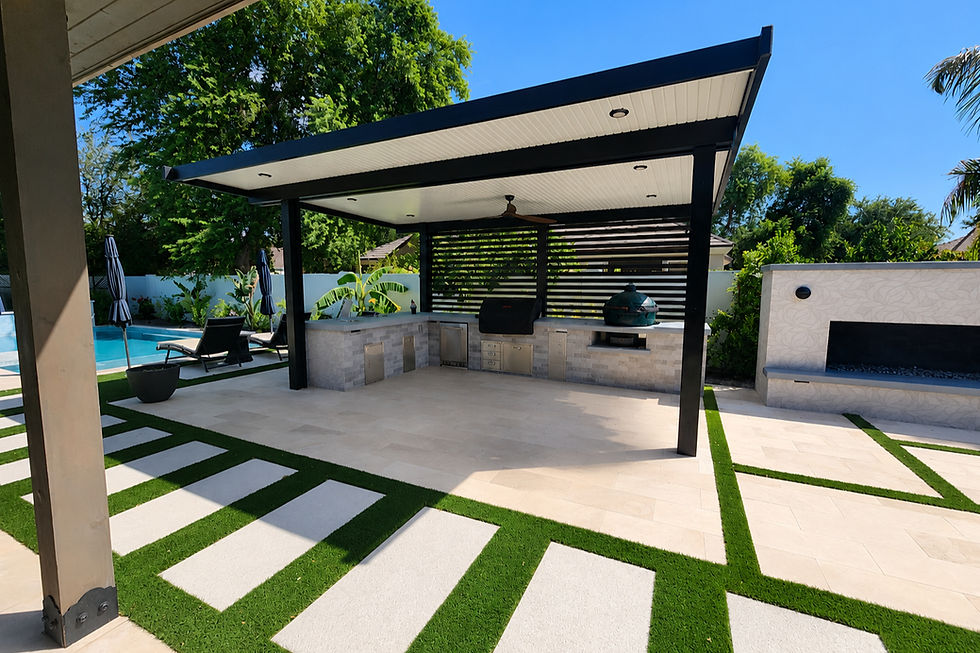
Insulated panel systems perform exceptionally well. My preferred product for solid-roof structures is Alumawood with insulated panels or solid wood with roof shingles. The difference in temperature underneath an insulated roof versus a non-insulated surface, or an open lattice structure, is significant. I've had clients tell me they can sit outside in July during the late afternoon because of this. That's not something most Arizona homeowners expect to say.

It opens up how you use the space. An outdoor kitchen under a solid roof is a different experience than one under a pergola. You can run ceiling fans, install lighting, mount a TV, and use the space during summer afternoons. With a pergola, you're always working around the sun.
Long-term comfort value. I've watched a lot of clients make the decision to go with a pergola to save money upfront, live with it for a summer, and then come back to me wanting to replace it. The savings don't always hold.
How Different Homeowners Should Think About This
This is where I think most articles on this topic fall short. The right answer depends on who you are and how you actually use your yard.
If you entertain outdoors regularly: Go with a ramada. You want guests to be comfortable, you want ceiling fans and lighting, and you want flexibility on timing. A solid-roof structure lets you host during weather you couldn't otherwise manage.
If you have an outdoor kitchen: A ramada is usually my recommendation. Cooking outdoors in Arizona summer under filtered light is uncomfortable for the cook and the guests. A solid roof keeps the area cooler while also protecting the food and the equipment. One exception might be for my snowbirds who are only here in the winter but go back to their cooler home states in the summer.
If you have a pool and want poolside shade: Consider a ramada for the primary shaded area. Pool decks reflect a significant amount of UV, and you need a solid retreat. A pergola nearby for aesthetic purposes is fine, but the shaded lounge area should have a solid roof.
If you mostly want a morning coffee spot or a winter entertaining area: A pergola can work. The burden on the structure is lower when it's not fighting July's afternoon sun.
If you have a smaller backyard: Scale matters. A pergola in a small yard can feel more proportional and open. A ramada in the same space might feel heavier. That's a legitimate design consideration.

A pergola can be a great fit for a smaller courtyard or patio area as it can make the space feel more proportional and open If you want to watch TV or use technology outdoors: A ramada. Glare makes screens unusable in filtered light. You need overhead coverage. (for more on this, see our upcoming article on the best technology for outdoor entertaining).
Mistakes I See Fairly Often
After doing this for three decades, the same patterns come up.
Choosing based on budget, then living with regret. A pergola that doesn't get used because it's too hot in the summer isn't a savings. Spending a bit more for a structure that actually changes how you live outside is usually worth it.
Building too small. A 10x12 pergola or ramada in a large backyard doesn't change the feel of the space. Homeowners who go small to save money often end up with a structure that's more of a focal point than a functional area. Think through how many people you realistically want to seat or how large the kitchen or lounge area will be, and size the structure around that.
Wrong orientation. A shade structure has to be positioned with the afternoon sun in mind. West-facing coverage during the hours of 2 to 7 p.m. is what you're building this for. I spend a lot of time with my clients walking their property before recommending where a structure goes, because the wrong placement means it doesn't do its job when you need it most. I covered a detailed story about this in the hot backyard article if you want to read it.
Forgetting about electrical. No fan. No lights. No outlet for a TV or speaker. These get added as an afterthought and can cost more to retrofit than if they'd been planned from the start. I always try to have this conversation with my clients first before we start construction.
Choosing a material that won't hold up. Wood is beautiful and real wood structures can last a long time in Arizona, but they do require consistent maintenance. Homeowners who don't stay on top of sealing and inspection end up with deterioration that can be more expensive to repair. Alumawood requires almost none of that, which is why I recommend it to most of my clients. I go into more detail on the material comparison in our Creative Shade Solutions article.
What About Combining Both?
There are a couple of different ways to combine both features into one outdoor project.
One approach is to design a ramada as the primary covered structure, positioned to handle the afternoon sun over the kitchen, dining area, or lounge, paired with a pergola nearby as a secondary feature or decorative element. The pergola adds visual layering and can anchor a garden area, a seating nook, or an entryway. You get the functional protection where you need it and the open aesthetic where it doesn't matter as much.
For larger backyard remodels, this kind of layered approach can work really well because there is ample space for it.
I've also worked on several projects where the home was already built with an extended solid roof patio and we were able to come in and add a pergola to it. This option can be a more economical and space conscious way to give the homeowner both forms of shade in a unifed space. I really enjoy designing these shade solutions because when done right, they can make a patio or outdoor living space feel cohesive and cooperative, instead of disconnected.

A third consideration for combining a pergola and ramada is the use of a louvered system, which allows the top of the structure to be fully closed or opened, depending on a homeowner's specific needs at any given moment.
Many companies offer these as kits that can be assembled on site by a contractor. I have not personally installed too many of these shade systems because they generally have a higher starting price point than that of a custom solid roof structure. However, for homeowners who want the flexibility, this can be a compelling option.
One note to consider about louvered pergolas is the maintenance. It is recommended that the tops are routinely cleaned, about every 2-3 weeks during monsoon season especially. If debris accumulates in the crevices of the louvers or, they aren't properly oiled, they can get damaged and cause malfunction. I spoke with one homeowner who told me while he loves the look and the "idea" of his louvered pergola system, he never actually opens it because he doesn't want all the maintenance that goes along with it.
Budget Considerations: What to Expect
You don't need to know the exact number before our first conversation, but it helps to go in with realistic expectations.
Alumawood pergolas and patio covers generally run in the range of $30-40 per square foot installed, depending on configuration, height, and attachments. Depending on design and scale, a solid-panel insulated roof costs more than a lattice top.
Wood structures run higher, typically $45-75 per square foot installed, depending on the wood species and complexity of the design. They look beautiful but carry ongoing maintenance costs that aluminum doesn't.
Masonry or steel custom structures vary widely by project and are quoted individually. These materials can also be mixed with real wood or Alumawood to create a shade system that is part of a larger outdoor kitchen or poolside structure.

One cost note worth making: the outdoor kitchen, lighting, fan, and electrical work are separate from the structure itself. When homeowners budget for a shade structure, they sometimes forget that everything going under it needs its own line in the budget. Our Phoenix Landscaping Costs breakdown discusses this in more detail if you want to explore further.
David's Two Cents
If this were my own backyard, I'd build a solid-roof ramada. Not because pergolas aren't beautiful, but because I live here. I know what July feels like, and I know that a structure I can actually sit under or cook under at 4 p.m. in August is worth every additional dollar over one I'd avoid until October.
If I had a larger yard, I'd probably also add a smaller pergola somewhere as a secondary element. I built this fun little setup at a client's recently (below) and I think it makes the perfect spot for anyone to curl up with their favorite book and just enjoy the outdoor space. No, you probably wouln't catch me reading a book, but I'd definitely be lounging there for a little Sunday nap.

Frequently Asked Questions
Is a ramada better than a pergola in Arizona? For summer comfort, yes. A solid roof blocks direct sun completely, which makes a meaningful difference in Arizona's heat. A pergola provides filtered shade and is more appropriate for morning use, evening use, or the shoulder seasons. For year-round, all-day usability, a ramada is the stronger choice.
Can you add a solid roof to an existing pergola? Sometimes. It depends on the structure, the posts, and the attachment points. We've definitely done conversions, but not every pergola is built to carry the load of a solid roof system. It's worth having someone look at the structure before assuming it can be upgraded.
What's the best material for a shade structure in Arizona? For most homeowners, Alumawood with an insulated solid panel system is my recommendation. It performs well in heat, requires almost no maintenance, and has a strong warranty. Wood is beautiful but does demand more upkeep. I cover both in detail in our Creative Shade Solutions article.
How big should my pergola or ramada be? Size it around how you'll use it. If you're covering a dining table for six and a grill area, you need more coverage than you think. Building too small is one of the most common mistakes we see. I frequently tell my clients that it's almost easier and less expensive to right the first time than trying to extend it later
Does shade structure orientation really matter? Yes, significantly. A structure positioned to shade the west-facing part of your patio during afternoon hours does far more work than one oriented differently. We look at sun angles before recommending placement on every project.
Can a pergola or ramada increase home value? A well-designed outdoor living space consistently adds value in the Arizona market. Buyers here understand what a functional covered patio means. The better the design and quality of materials, the better the return.

Ready to Figure Out Which One Is Right for You?
Whether you're leaning toward a pergola, a ramada, or you're still somewhere in between, that's exactly the kind of conversation we have during our free consultations. Oasis Green has been designing and building outdoor living spaces throughout Gilbert, Chandler, Mesa, Queen Creek, and the East Valley since 2006, helping homeowners find solutions that fit both their lifestyle and their budget.
One thing you'll notice throughout this article, and throughout our blog, is that we intentionally showcase real projects that our team has personally designed and built here in Arizona whenever possible. We believe seeing actual backyards is far more helpful than looking at generic stock photos downloaded from the internet.
If one of the pergolas or ramadas featured in this article inspired you, we'd love the opportunity to show you how we can create something similar- while customizing it to fit your own home, style, and outdoor living goals.
Feel free to browse our project gallery for even more examples of real Arizona backyards, or schedule a free consultation and we'll walk your space together, answer your questions, and help you decide which shade structure is the right fit for your family.
At Oasis Green, we believe the best outdoor spaces are built around the families who use them. We'd be honored to help you create yours.