.png)
Phoenix Landscaping Trends in 2026: What Homeowners Are Actually Asking For

Updated: Sep 10
I've been designing and building landscapes in the Phoenix metro for over three decades now, and if there's one thing I've learned, it's that what homeowners want in their backyards is always shifting. This year has been one of the more interesting stretches I've seen in terms of design trends, and a lot of it comes down to how people actually want to live in their outdoor spaces.
Here's what I'm seeing out there in Gilbert, Chandler, and across the Valley this year. These aren't trends I'm reading about online, they are requests my team and I are getting weekly from homeowners who are ready to transform their properties into something truly special.
Outdoor Rooms Are Getting Serious
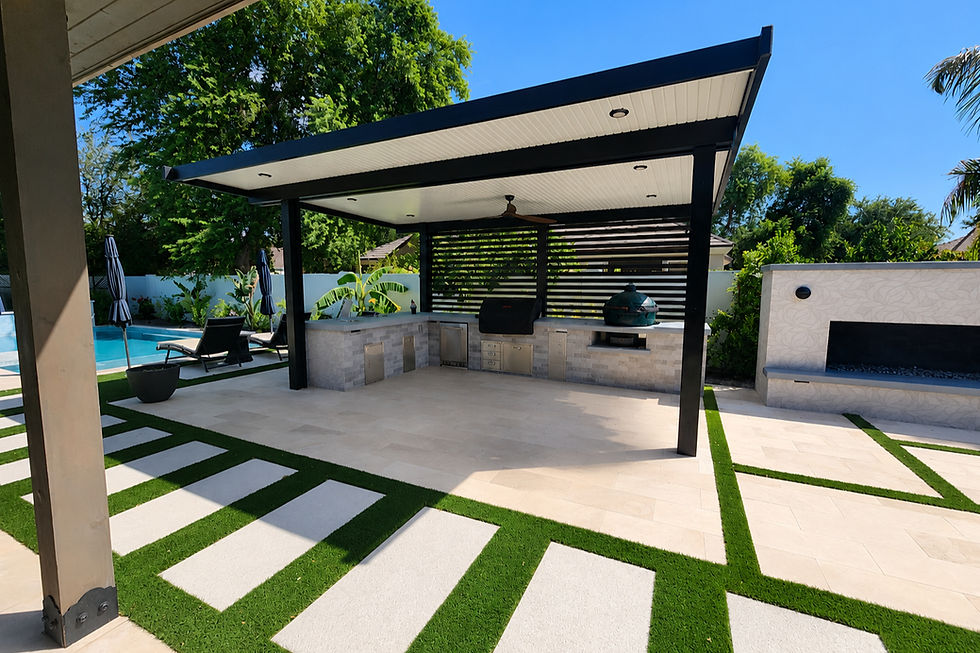
I recently wrapped up a project in Queen Creek where we basically built what I'd call a "second living room" outside. And I'm not talking about just throwing a patio set on some pavers and calling it good. Homeowners this year want their outdoor spaces to function like actual rooms, with defined purposes, comfortable year-round use, and all the amenities you'd expect indoors.
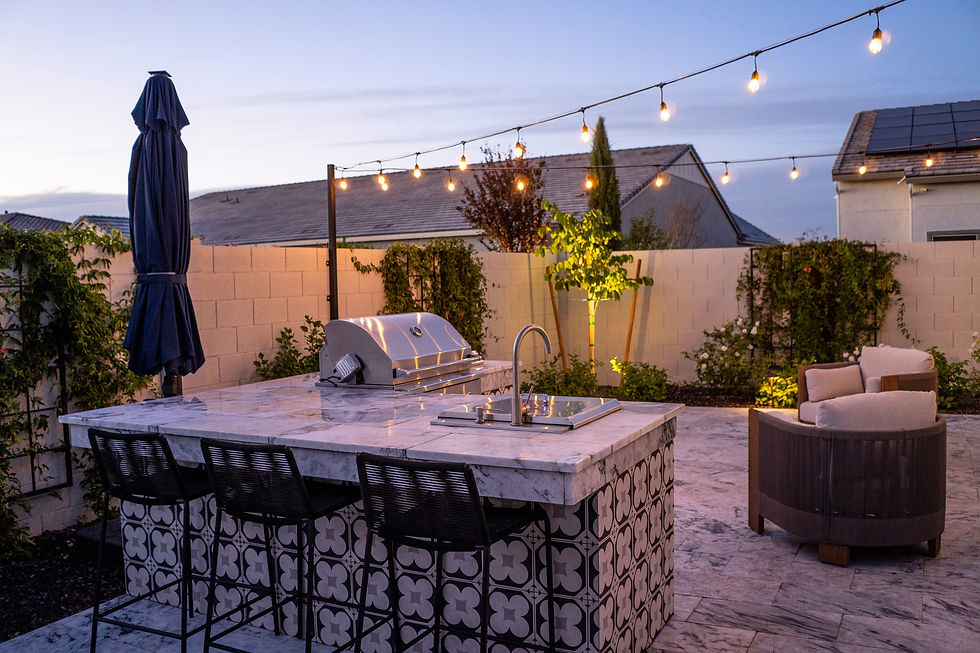
We're talking full outdoor kitchens with sinks and refrigeration, outdoor TVs mounted on custom entertainment walls, and honestly, the requests for outdoor fireplaces and water features are not slowing down. People realize that our Phoenix winters are absolutely perfect for enjoying a fire feature, and they don't want to waste those gorgeous November through March evenings sitting inside.

What Makes an Outdoor Room Actually Functional in Phoenix:
Substantial shade structures – Alumawood ramadas or pergolas with ceiling fans can drop temps by 15-20 degrees, making spaces usable May through September
Multiple zones – A cooking area near the house, conversation space with a firepit, and maybe a quiet reading nook all serve different purposes
Built-in seating – Custom bench seating with cushions looks sharp and eliminates the need to store patio furniture during monsoon season
Adequate lighting – You want to use these spaces after dark, so plan for ambient, task, and accent lighting from the start
Durable materials – Our extreme temperature swings and UV exposure will destroy cheap materials in just a few years
One increasingly popular 2026 landscaping trend I'm particularly excited about is the rise of "zoned outdoor living." Instead of one giant patio that tries to do everything, homeowners are asking for multiple distinct areas. It makes so much sense when you think about it. Your indoor spaces have different rooms for different purposes, so why shouldn't your backyard?
I've done several of these types of projects so far. If you want to see how this plays out in a full backyard build, I walked through it in more detail in Transform Your Backyard into the Ultimate Entertainment Oasis.
I recently completed a project in Gilbert that had several different zones, as the family likes to entertain and wanted to ensure they had comfortable and sufficient places for all their guests. In addition to an outdoor kitchen and dining area, we built a sitting area near a linear firepit on one end of the pool, a yoga and relaxation zone under a covered ramada next to a fish pond, and a jacuzzi zone under a pergola with a nearby outdoor shower.

Artificial Turf Is Finally Being Done Right
Look, I'll be honest, twenty years ago I wasn't always the biggest fan of artificial turf. Early products looked a little fake, and got pretty dang hot in the summertime. However, artificial turf manufacturers have upped their game and the technology has come so far that I'm now recommending it for the majority of my clients looking for a green lawn as part of their landscaping project.
Here's why this landscaping trend keeps growing: Phoenix families, including my own, want green space without the water bill and maintenance headaches of real grass. With water rates climbing across the state and drought restrictions in some areas getting stricter, artificial turf just makes financial sense.
But more importantly, as the artificial turf technology keeps improving, newer products look incredibly realistic, stay cooler, and protect even better against odors than the older stuff.
We recently remodeled a backyard in Chandler and installed a premium artificial turf that has a brown thatch layer mixed in with the green blades. I gotta say it looks pretty incredible. For this project, we used a specially formulated pet infill under the turf to keep the area cooler and combat any smells from the owners' dogs using the space.
I'm not just seeing new homes request artificial turf either, there are plenty of older homes opting to replace their lawns with turf because they've done the yearly overseeding and the weekly mowing and they are ready for something that looks gorgeous year round and frees up their Saturdays.

Critical Installation Steps for Arizona (Don't Skip These):
Proper excavation – Remove 3-4 inches of existing soil to accommodate base materials
Compacted base rock – This creates stability and prevents settling in our expansive soils
Decomposed granite layer – Provides a smooth, stable surface for the turf backing
Quality drainage – Essential for monsoon rains and occasional irrigation overspray
Heat-reflective infill – New infill technologies keep surface temps 20-30 degrees cooler than older products
The biggest mistakes I see DIYers make with artificial turf are purchasing cheap knockoff products and skimping on base preparation. Cheap imitation products don't stand a chance against our Arizona heat and sun. We've had to replace many lawns over the years done by others who used inferior products. Make sure whatever turf you purchase comes with a good manufacturer's warranty and that it's made specifically for hot climates like ours.
As for skimping on base prep, in Arizona, our soil expands and contracts with moisture and temperature changes, so you absolutely need a properly compacted base with good drainage, or you'll have a wavy, bumpy mess within a year. It's not sexy work, but it's what separates a turf installation that lasts 15-20 years from one that looks terrible in 2-3 years.
One thing I'm seeing more of and getting more requests for is artificial turf mixed with other hardscape elements, like turf play areas surrounded by pavers, or geometric turf sections bordered by decorative rock or pavers. It creates really nice visual interest and breaks up what could otherwise feel like a big green carpet.
David's Two Cents: If you're on the fence about real grass versus turf, don't just take my word for it here. I wrote a full comparison breaking down cost, maintenance, and which one actually makes sense for different lifestyles in Real Grass vs. Artificial Turf: Which is Better for Phoenix Yards? And if pets are part of the equation, that changes things too. Worth a read before you decide either way.
Desert Modern Is Evolving
The desert modern aesthetic has been popular in Scottsdale and North Phoenix for years, but it's evolving into something more refined this year. We're moving away from the stark, minimalist look with nothing but gravel and a few cacti, and instead creating what I'd call "sophisticated desert living."
This means incorporating desert-adapted plants, but in a much more lush and layered way. Think about using plants like Red Yucca, Desert Spoon, Texas Sage, and various Agave species, but designing them in mass plantings that create texture and fullness rather than scattered individual specimens. We're also using a lot more ornamental grasses like Pink Muhly and Deer Grass to add movement and softness.

Top Plant Choices for Layered Desert Modern Designs:
Pink Muhly Grass – Creates stunning pink plumes in fall, adds movement and softness
Red Yucca – Coral-colored blooms spring through fall, hummingbirds love it
Texas Sage – Blooms purple after monsoon rains, extremely drought-tolerant once established
Deer Grass – Native ornamental grass that provides texture year-round
Desert Spoon – Architectural form with silvery-blue foliage, super tough
Red Bird of Paradise – Brilliant orange blooms for months, works as a small tree or large shrub
Bougainvillea – Explosive color all summer if you've got the space and wall exposure

The color palette for hardscape in this style is shifting too. We went through the browns and golds era, straight into varying shades of grey that dominated for the past decade. This year, I'm continuing to see more requests for warm earth tones, think buff, tan, greige, and a good mix of materials with the hardscape. Think metal, natural wood accents, and light-colored natural stone.
What I love about this evolved desert modern approach is that it works cohesively with our environment and climate while still creating spaces that feel inviting and livable. You're not sacrificing beauty or functionality, you're just working smarter with what thrives here naturally.
Water Features Are Making a Comeback (With a Twist)
Here's a 2026 landscaping trend I'm especially excited to see: water features are back in a big way, but they're different than the elaborate rock waterfalls that were everywhere in the early 2000s. Today's water features in Phoenix landscapes are more architectural, more intentional, and way more water-efficient.
I've installed or remodeled probably a dozen custom water features in the past six months alone, and most of them are contemporary designs, think clean-lined water walls, geometric fountains, or sleek spillways integrated into ground level or raised planters. These designs use significantly less water than traditional features because they're self-contained and recirculating, with minimal evaporation loss.
The sound of water is just so valuable in our environment. It masks traffic noise, creates a calming atmosphere, and honestly, there's something psychologically cooling about hearing water when it's 110-115 degrees outside. I am noticing water features have been especially popular with my 55+ clients whose days of maintaining a big family pool are gone, but they still want to enjoy the peace and ambiance that comes from an outdoor water feature. They're also great options for families who just want to dip their toes in some flowing water now and again but aren't necessarily looking for a pool or spa.
One popular design I'm continuing to build in 2026 is an integrated fire and water feature in one structure. You get this amazing contrast of fire and water elements together, and it becomes a real focal point for the entire backyard. I just finished one recently where we built a stacked stone wall with a linear fireplace in the center and a water feature cascading down on each side into a pool below. It turned out absolutely killer.
For a deeper dive into the different styles and how to choose between pre-fabricated and fully custom builds, see A Guide to Water Features in Desert Landscapes.

Multi-Functional Sports Courts and Play Areas
This one's been growing steadily, and this year has been no different. Sport courts and play areas continue to be popular choices because families want their kids outside and active. With Arizona's year-round weather, it makes total sense to invest in a basketball half-court or volleyball court. This month alone I've already gotten requests for a bocce ball court, a multi-sport court, and an in-ground trampoline.
What's interesting is how we're integrating these into the overall design rather than treating them as afterthoughts. A basketball court doesn't have to be this ugly slab of concrete in the corner of your yard. We're strategically landscaping to make these areas look intentional and attractive even when they're not in use. The image below is a sport court we installed recently that can be used for both basketball or pickleball.
Pickleball courts are the new hot thing, by the way (even my wife took it up this year). I get asked about them constantly. The challenge is that a regulation pickleball court is 20' x 44', which takes up a significant chunk of most residential lots. But for homeowners with bigger properties in parts of Gilbert, Queen Creek, or North Scottsdale, we're finding creative ways to make it work, sometimes as a multi-use court that can serve for pickleball, basketball, or even just a large entertaining space when needed.

For more on planning these spaces well, I covered it in Guide to Selecting the Perfect Sport Court or Play Area for Your Arizona Yard.
Lighting Is Getting Smarter and More Dramatic
Low voltage landscape lighting has always been part of my projects, but the way we're approaching it this year is totally different. LED technology has improved so much that we can create really dramatic effects with minimal energy use, and smart controls mean homeowners can adjust everything from their phones.
Lighting Techniques That Transform Phoenix Landscapes:
Uplighting architectural features – Highlight ramada columns, textured stone walls, or the trunks of mature trees
Backlighting specimen plants – Place fixtures behind Desert Spoon or Saguaro clusters for stunning silhouette effects
Recessed path lighting – Provides safety without the obtrusive "mushroom light" look
Wash lighting on walls – Creates ambient glow and makes outdoor rooms feel more intimate
Accent lighting for water features – Submersible LEDs that can change colors for different moods
Smart controls – Program different scenes for everyday use, entertaining, or security
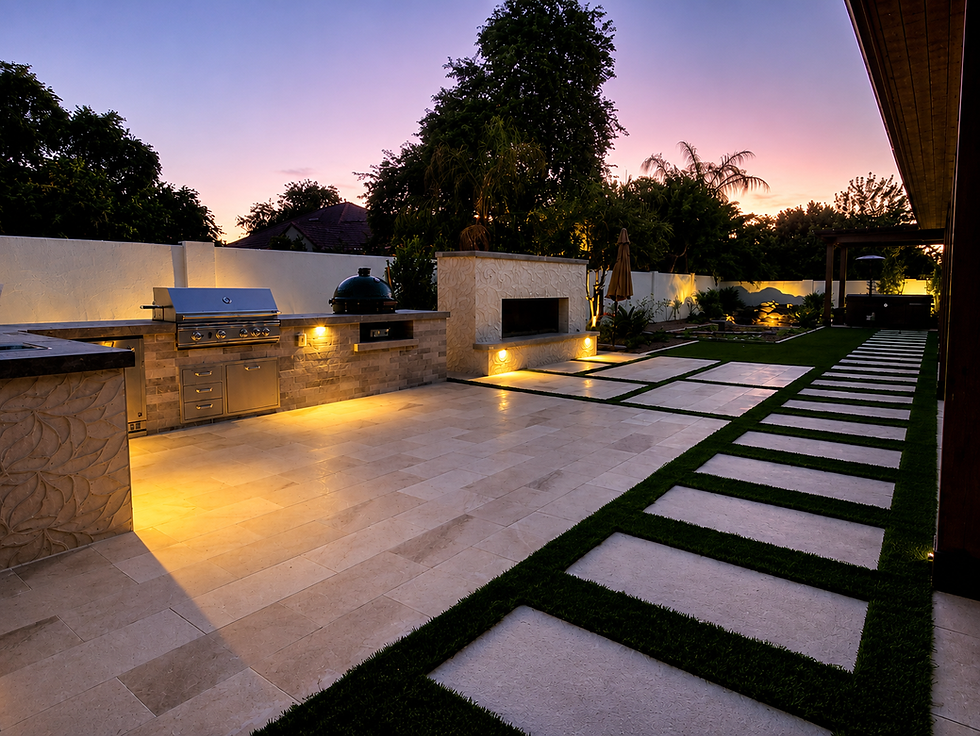
I'm doing a lot more uplighting on architectural features, like highlighting the columns of a ramada or washing light up a textured stone wall. Lighting installed directly into masonry structures like water features and outdoor kitchens provides both safety and ambiance. Path lighting is getting more subtle and sophisticated too. Instead of those mushroom lights every few feet that scream "landscape lighting," recessed fixtures and bollard lights are also popular options that provide safety and visibility without being obtrusive.

One technique I really like is backlighting. When you put lights behind a specimen plant like a Desert Spoon or a cluster of Saguaros, the silhouette effect at night is just stunning. It creates this dramatic shadow play that adds so much depth to your landscape after dark. This can be a really nice effect for my clients with larger properties who want to make sure the back of their yard doesn't disappear when the sun goes down.
The smart control aspect is huge for Phoenix area landscapes too. You can program your lights to come on at dusk automatically, or set them on a timer that can be adjusted seasonally and for special occasions. While party lights on ramadas are still popular, there is definitely added interest this year in incorporating LED lighting strips into landscape designs.
We project we just finished in San Tan Valley is a sleek, modern fire pit area surrounded by artificial turf and it is now the focal point of our clients' backyard. It has a sunken built-in seating area surrounding a linear firepit with Govee LED strip lights installed under the seats and steps. The clients are able to change the light colors and patterns to fit the mood or theme of their outdoor gatherings or keep them off if they want to focus solely on the fire. The bonus for this outdoor lighting system is that it works with Alexa, Google Assistant, or straight from an app so it's also super convenient to use.


Sustainability Without Sacrifice
Here's maybe the biggest shift I'm seeing: homeowners want sustainable, water-wise landscapes, but they don't want to sacrifice beauty or livability. This isn't about turning your yard into a cactus garden unless that's genuinely your style. It's about making smart choices that reduce water use and maintenance while still creating lush, inviting spaces.
Drip irrigation is basically standard on every project we do. The days of spray irrigation drenching entire yards are mostly over, at least for new installations. Drip systems deliver water directly to plant roots, reducing evaporation and ensuring every drop counts. We're also installing smart controllers like the Hunter Hydrawise HPC400 Smart WiFi Irrigation Controller (our favorite!) that can be controlled remotely over WiFi and allows our homeowners to adjust watering schedules based on weather data and actual plant needs.
Smart Water Conservation Strategies That Actually Work:
Drip irrigation systems – Deliver water directly to roots with minimal evaporation loss
Smart irrigation controllers – Adjust schedules based on weather data and actual plant moisture needs
Hydrozoning – Group plants with similar water needs together for more efficient irrigation
Rainwater harvesting – Channel roof runoff to planted areas or collection basins
Desert-adapted plant palette – Beautiful options that thrive with less water once established
Native and desert-adapted plants are the foundation, but here's the thing, you can create incredibly diverse, colorful landscapes using plants that thrive in our climate. Red Bird of Paradise blooms for months with brilliant orange flowers. Bougainvillea gives you that explosion of color all summer. Desert Willow provides shade and gorgeous trumpet-shaped blooms. Texas Sage blooms purple after our monsoon rains. You're not limited to brown and tan if you choose wisely.
David's Two Cents: Every year I get a handful of clients who think "water-wise" means giving something up. It doesn't. Some of my favorite finished yards this year are also some of the lowest water users I've built. The trick is layering textures and bloom times so something is always popping visually, even when nothing's actively flowering. That's smart design, not deprivation.
Why This Matters for Your Property
Trends are interesting to talk about, but here's what really matters: creating an outdoor space that works for how you actually live and adds real value to your property. The best landscapes aren't just following whatever's popular, they're solving problems and meeting your specific needs.
Maybe you're the family everyone counts on for Sunday dinners and year-round gatherings. Maybe you want a private retreat where you can relax after work. Maybe you've got kids and dogs who need room to play, or you're empty nesters who finally want that outdoor kitchen you've been dreaming about for twenty years. Whatever it is, the trends I'm seeing this year are all about making Phoenix backyards more functional, more beautiful, and more aligned with how we actually want to live in this incredible climate we've got.

After 30+ years doing this work, I can tell you that the homeowners who are happiest with their landscapes are the ones who invested in quality design and construction from the start. Cutting corners on base preparation, using cheap materials, or skipping important features like adequate shade almost always leads to regret and expensive fixes down the road. If you want a sense of realistic numbers before you start planning, I broke that down in How Much Does Landscaping Cost in Phoenix? A Local Expert's Real-World Pricing Guide and the feature-by-feature follow-up, Phoenix Landscaping Features: What Each Element Costs in 2026.
Frequently Asked Questions
Is artificial turf actually worth it for Phoenix yards in 2026? For most of my clients, yes. The newer products handle heat better, look more realistic, and the water savings add up fast given where rates are headed. It still depends on your specific yard and goals though, which is why I always recommend weighing it against real grass first.
Do I need a shade structure if I already have patio coverage from my house? Usually yes. Most builder patios only cover a small footprint near the house. If you want to actually use your backyard through the hottest months, a ramada or pergola further out in the yard makes a much bigger difference than people expect.
Are water features practical in a desert climate, or do they waste water? Modern recirculating water features use far less water than people assume. They're self-contained systems, not constantly draining and refilling, so evaporation loss is minimal compared to older designs.
What's the most requested feature you're building right now? Outdoor kitchens and fireplaces, hands down, especially when they're designed together as one cohesive entertaining space rather than two separate add-ons.
Let's Talk About Your Project
If you're in the Phoenix metro and you're ready to transform your outdoor space, whether you're building from scratch on new construction or completely renovating an existing landscape, I'd love to sit down and talk through what's possible for your property. We offer free consultations where we can walk your property together, discuss your vision and needs, and start putting together a design that makes sense for your lifestyle and budget.
The projects we're designing and building this year are some of the most exciting I've ever been involved with, and I genuinely love helping homeowners create spaces they'll enjoy for decades to come. Schedule your free consultation and let's start talking about how we can bring these trends to life in your own backyard.