
Backyard Remodel Mistakes: 11 Costly Errors to Avoid Before You Build in Arizona

Updated: 1 day ago
A backyard remodel is one of the bigger checks most homeowners will write for their house. Once it includes an outdoor kitchen, a ramada, a fire feature, or a spa, it's often the largest project you'll take on after buying the home itself.

In more than 30 years of designing and installing landscapes around the Valley, I've noticed that the most expensive mistakes rarely happen with a shovel in the ground. They happen earlier, at the kitchen table, when a homeowner picks a contractor, approves a layout, or signs a proposal without knowing what to look for.
Arizona adds its own pressure to those decisions. Our summer sun, monsoon downpours, hard caliche soil, and irrigation needs punish shortcuts that might go unnoticed somewhere else.
Some of the mistakes below cost a few hundred dollars to fix. Others can stop a project halfway through or cost you your deposit. I've seen both, and I'd rather you read about them here than live through them.
If you're still in the early stages, my earlier article on the 12 biggest landscaping mistakes Arizona homeowners make covers plant care, watering, and turf. This article focuses on the remodel itself: who builds it, how it's planned, and what's in the contract.
Mistake 1: Hiring an Unlicensed Contractor or One With a Suspended License
This is the mistake I'd most like to help you avoid, because it's the one that can turn a remodel into a legal and financial mess. Two experiences from our own office show how differently it can play out.
The Remodel That Stopped Halfway
Recently, I met with a couple planning a large backyard remodel. I walked the property, listened to what they wanted, and put together a custom design and a detailed proposal. They liked both, but in the end they hired another landscape contractor.
That's normal. Homeowners should compare contractors, and I don't take it personally when someone goes another way.
Several months later, they called us back. Their contractor had already started construction when they learned his contractor's license had been suspended. The work stopped, and their backyard sat torn up and unfinished.
They asked if I would come back out, reassess what had been done, and put together a new proposal to finish what the other contractor started. Fortunately, they hadn't lost much beyond time and the disruption of living with a half-built yard. Plenty of homeowners aren't that lucky.

The lesson: confirming that a contractor has a license isn't enough. You need to know the license is active right now and that it covers the work you're hiring them to do.
The Homeowners Who Lost Their Money
Some of my hardest first meetings are with homeowners who are understandably skeptical of contractors. More than a few of them paid an unlicensed landscaper a deposit, watched part of the work get done, and then never heard from that person again.
We see it play out publicly, too. Every so often, a post shows up in a local community group from a homeowner asking for a referral to finish a project after their contractor took the money and disappeared. By the time they're asking, they've usually lost the deposit, have an unfinished yard, and aren't sure who to trust.
Now I'm not saying that every unlicensed worker is intentionally dishonest, nor am I saying that a license automatically guarantees great workmanship or project completion. What a license does give you, however, is accountability and options you wouldn't have otherwise.
What an Arizona ROC License Protects
In Arizona, contractors are licensed by the Arizona Registrar of Contractors (ROC). It's generally unlawful to bid on or perform construction work without a license. There's a narrow exemption for small, minor jobs that don't require a permit, but a major backyard remodel isn't one of them.
Most landscape and hardscape work falls under the ROC's hardscaping and irrigation classification (R-21 for residential work, or CR-21 for a dual license). Parts of a project like gas lines, electrical, or a pool may fall under other classifications, so ask who will handle each part of the job and check those licenses too.
When you hire an appropriately licensed residential contractor, you have access to protections you wouldn't have otherwise:
The ROC complaint process. The ROC can investigate poor workmanship or abandoned work by a licensed contractor.
The contractor's license bond. Licensed contractors are required to carry a bond.
The Residential Contractors' Recovery Fund. This state fund can pay eligible homeowners up to $30,000 per claimant per residence for losses caused by a licensed residential contractor, with a $200,000 maximum per contractor license. You generally have to go through the ROC complaint process before filing a claim.
The Recovery Fund has limits, and eligibility depends on details like whether the home is your primary residence and the timing of your contract. A license that's suspended after you sign doesn't necessarily erase the protections you had. Unfortunately, if the contractor was never licensed, the Recovery Fund generally isn't available to you.
That doesn't mean you have no options if you hired someone unlicensed. Contracting without a required license is a misdemeanor in Arizona, so you can report it to the ROC, and you may be able to pursue civil remedies. Those paths are usually slower and less certain, which is why checking first matters so much.
What about using a pool company for your landscaping?
If you are having a pool built and intend to use the pool builder for landscaping, an outdoor kitchen, or hardscape beyond the pool itself, there are extra questions you should consider. Pool contractors are legally limited in performing extensive hardscaping, grading, or irrigation installations beyond what their pool license allows unless they also hold the required landscaping license or plan to subcontract the work to a licensed contractor.
How to Check a Contractor Before You Pay a Deposit
This takes about five minutes on the Arizona ROC website:
Ask for the contractor's ROC license number.
Look the license up yourself on the ROC website instead of relying on a number printed on a truck or business card.
Confirm the license is active and its classification covers the work in your proposal.
Review any complaint and disciplinary history the ROC lists.
Make sure the business name on the license matches the company on your contract.
Get a detailed written contract before you pay any deposit.
David's Two Cents: Before agreeing to work with a landscape contractor, ask for the license number. A good contractor hands it over without a second thought. If someone gets vague, offers to work under a "buddy's" license, or wants the full project amount up front to get started, walk away. A low price on an unlicensed job isn't a deal. It's a risk you carry alone.
Already Dealing With an Unfinished or Abandoned Project?
If you're reading this and you're dealing with an unfinished or abandoned project, here's where I'd start.
Inform your contractor that you'll be contacting the ROC. If there's a legitimate reason for the delay or a simple misunderstanding, they'll be anxious to correct the problem before the ROC gets involved.
File a complaint with the ROC. If you've already tried reaching out to your contractor and they've repeatedly ignored you, a complaint is how the ROC gets involved in having the work corrected or completed by your licensed contractor. It's also the first step toward the Recovery Fund in most cases. Deadlines apply, so don't wait.
Document everything. Keep your contract, proof of every payment you made, texts and emails, and dated photos of the work as it stands.
Get itemized bids from licensed contractors. A Recovery Fund claim requires proof of what it will cost to finish or repair the work, and bids from unlicensed businesses don't count.
Check whether you're eligible for the Recovery Fund. Your contractor must have been properly licensed when you signed the contract, made your first payment, or when work began, and the home generally needs to be your primary residence. The ROC's Residential Contractors' Recovery Fund page explains the requirements and each step.
If your contractor was never licensed, report it to the ROC anyway, and talk with an attorney about civil options, since the Recovery Fund won't apply.
When you're ready to move forward, verify the license of whoever you hire to finish the job. Assessing what another contractor left behind and planning how to finish it starts the same way as any other project with us: a walk through the yard.
Mistake 2: Designing Around Trends Instead of How You Live
Pinterest and Instagram are great for inspiration, and we use them to showcase our own projects. We even encourage clients to bring photos to our first meeting because they show me the style someone is drawn to faster than words can. Where people get into trouble is building to fit the photo instead of the yard they'll use.
A sunken fire pit lounge looks great online. It's less fun with a toddler and a dog who both like to run full speed across the yard. A large outdoor kitchen makes sense for someone who grills four nights a week, but it may sit idle for someone who hosts a few times a year.
Before we talk about features, I ask questions like these. Who uses the yard on a normal weeknight? Do you entertain big groups or a few friends? Do you have kids or pets? How much time do you want to spend maintaining it?

I also think about how people move through the space. You should be able to walk from the back door to the grill, from the grill to the table, and from the table to the pool without weaving around furniture or stepping into a planter. And a yard used mostly on winter evenings needs different things than one used on summer mornings.
Start with how you want to live out there, then choose the features that support it.
Mistake 3: Leaving Shade Until the End
In the Phoenix area, shade isn't simply an accessory. A west-facing patio can be unusable from mid-afternoon until well after sunset for months at a time, no matter how nice the furniture is.
The mistake I see most in remodels is treating shade as something to add once the budget allows. The patio gets installed, the kitchen gets built in the sunniest corner, and the ramada gets squeezed in later wherever it fits. By then, footings, roof lines, and the electrical for fans and lights are much harder to place.
I start by looking at how the house sits on the lot. A north-facing backyard gets more shade from the house itself. A west-facing yard takes the full afternoon sun, so the kitchen and main seating need cover built into the plan from day one.
The type of shade matters too. A solid-roof ramada blocks direct sun and rain and can carry ceiling fans and lighting. A pergola with open slats filters the sun, but it won't keep you nearly as cool on a July afternoon. Trees shade and cool the air around them, but they can take years to fill in. I compare the two structures in detail in Pergola vs. Ramada: Which Shade Structure Is Best for Arizona Homes?
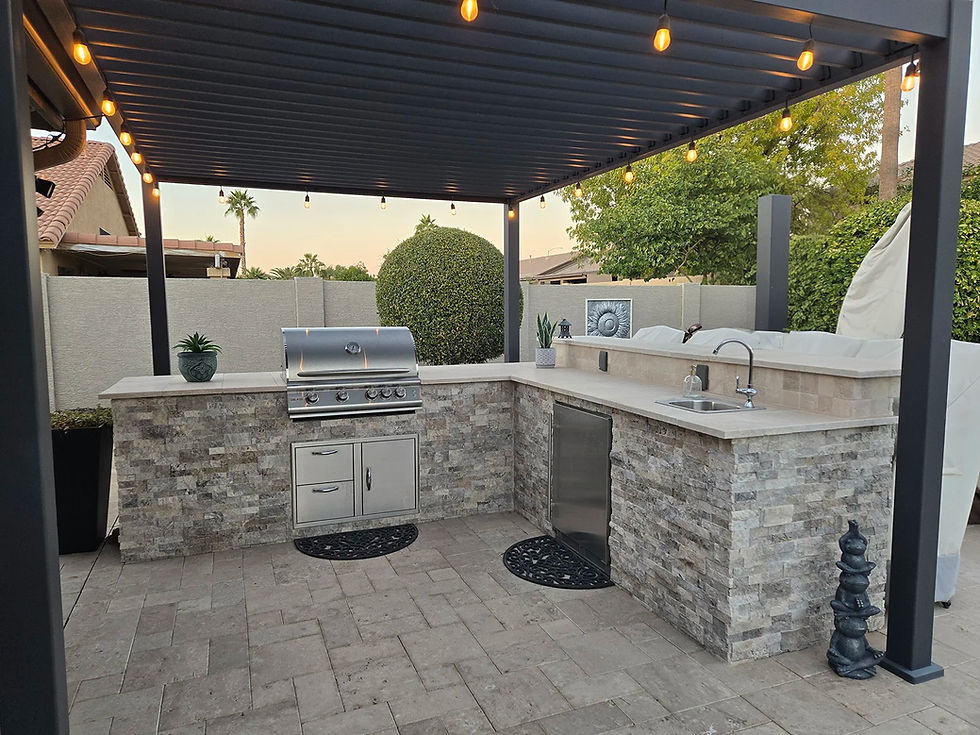
An outdoor kitchen without shade tends to become a very expensive countertop for half the year. Put the cooking and seating where people will be comfortable, then design the rest of the yard around them. If your yard already feels too hot, Why Is My Backyard Still Hot? walks through the common causes.
Mistake 4: Choosing Hardscape Materials Based on Looks Alone
Material samples are easy to fall for in a showroom. Out in the yard, they have to handle 115-degree days, intense UV, monsoon rain, and often pool water and bare feet.
Heat is the first thing I talk through. For example, darker pavers and stone are beautiful, but they hold more heat than lighter ones. That's not to say that darker pavers can't be used in a design. We use them all the time. It's the placement of the dark materials that makes the difference. Using dark materials as accents on media walls or fireplaces will have a much different effect on your comfort than using them for full patio decking or the top of built-in seating.

Around pools and spas, slip resistance is another thing to take into consideration. A smooth or polished finish that looks sharp when it's dry can be slick when it's wet. For decks and steps near water, I try to steer clients toward textured or tumbled finishes.
Then there's long-term care. Natural stone needs sealing and maintenance on a schedule, and some finishes show stains and hard-water spots more than others. Before you select a hardscape material for your yard, it's important that you understand what the maintenance looks like for that particular material. I cover that in more detail in my article, How to Care for Natural Stone Patios and Pool Decks in Arizona.
Installation counts as much as the material. Pavers set on a poorly compacted base will settle and shift no matter how much they cost. Before you choose, look at full-size samples in your own yard's light, and ask your contractor how the base will be prepared.
Mistake 5: Overlooking Drainage and Grading
Drainage is easy to forget in the desert until a monsoon storm dumps a heavy burst of rain in a short window. When that happens, every new patio, wall, planter, and step in your yard changes where that water goes.
Most East Valley lots were graded by the builder to move water away from the house and toward the edges of the yard or a retention area. A remodel that adds hardscape can block those paths without anyone noticing until the first big storm sends water toward the back door or leaves it pooled against the foundation.
Standing water causes its own problems: stained or shifting pavers, soggy turf, mosquitoes, and moisture sitting against the house.
I plan elevations and drainage before anything else gets placed. Depending on the lot, that might mean sloping a patio slightly away from the house, adding drains, or using a lower part of the yard as a retention area. The right solution depends on your lot's grade, your soil, and any retention your city or HOA requires.
Getting this right during design costs very little. Fixing it after the patio is finished can mean tearing out and resetting hardscape. I explain how elevation and drainage work together in How to Add Elevation to Your Arizona Backyard With Walls, Steps & Planters.
Mistake 6: Not Planning for Future Phases
Doing a backyard in phases is a smart way to manage a budget, and many of my clients do it this way. The mistake isn't phasing. It's building phase one without a plan for phases two and three.
The most common example is adding an outdoor kitchen a few years after the patio is finished. If nobody ran gas, water, or electrical lines under that patio, we either cut into finished pavers or route everything the long way around.
The same goes for future spas, fire features, ramadas, and landscape lighting. Each one needs some combination of gas, power, water, drainage, footings, or room for equipment to get in.
When I design a phased project, I lay out the whole yard first. During the first phase, we run sleeves or stub out gas, water, and electrical lines where later features will go, and we keep access routes open for equipment. It adds a little to phase one and can save you the cost of demolition and rebuilding later.
Mistake 7: Choosing Plants That Don't Fit the Spot
I covered plant selection in depth in my earlier mistakes article, so here I'll focus on how a remodel changes the picture.
New hardscape changes the conditions your plants live in. A bed beside a new west-facing wall or pool deck gets reflected heat on top of direct sun. A spot that used to get full sun may sit in shade once the ramada goes up. Plants need to be chosen for the yard as it will be, not as it was before.
I learned this the hard way several years ago at my own home when we decided to build a garden bed in the side yard. I put the garden bed right up against the west-facing wall to make room for a citrus tree. At the time it seemed like the perfect way to maximize the space.
Sadly, when it hit summer temperatures the radiant heat off of the wall was too much for the majority of my delicate plantings and nearly everything died. I tried replanting seedlings two or three more times before I realized my mistake.
Mature size is another consideration that matters even more around hardscape. A tree that looks right on installation day can lift pavers, crowd a walkway, or drop leaves into the pool within a few years. Consider it before the renovation so you aren't left with major problems a few short years later.
See Best Plants for Arizona Landscaping for the plants, shrubs, and vines I recommend for Arizona homes.
Mistake 8: Treating Landscape Lighting as an Afterthought
For much of the year, Arizona backyards get their heaviest use after the sun goes down. A yard without a lighting plan ends its day at sunset.

Good landscape lighting does a few jobs. It lights steps and paths so nobody trips. It makes the kitchen and dining areas usable. And it highlights the trees, walls, and water features you invested in. Restraint is the key: soft, layered light looks better than a few bright floods, and fixtures should be aimed so they don't glare into anyone's eyes or the neighbor's windows.
Like utilities, lighting is far easier to plan before hardscape goes in. Wire runs can go under patios and through walls during construction. After the fact, wires often end up along the surface or under rock where they're easier to damage. For ideas, see Top 5 Landscape Lighting Ideas for Enjoying Arizona Evenings.
Mistake 9: Squeezing Too Many Features Into the Space
I regularly see wish lists that include way too many features for the intended space: an outdoor kitchen, a spa, a fire pit, a water feature, turf for the kids, and a sport court, all in a standard East Valley backyard. I understand why. Each one sounds good on its own.
Packed into one yard, however, they can make the space feel smaller and harder to use. Walkways shrink, furniture has nowhere to go, and nothing has room to be the focal point.
It all comes down to scale. A dining table for eight needs room to pull the chairs out, and I like main walkways to be about 4 feet wide so two people can pass. I'd rather build four features well than try to cram in six or eight.
When my clients are really set on having several features in a smaller space, I look for features that can be combined or do double duty. A seat wall can hold back a raised planter and give guests a place to sit. Water and fire can be combined into one feature, and even an outdoor kitchen can be designed with built-in seating.
Changes in elevation can divide spaces without adding walls. I go into this more in What Makes a Backyard Feel Expensive? and Make Every Foot Count: A Landscape Designer's Guide to Small Backyards.
If everything won't fit, pick the features that match how you'll use the yard most, and save room in the plan for the rest.
Mistake 10: Choosing a Contractor Based on the Lowest Bid Alone
Comparing bids is smart, and I tell clients to meet with more than one designer. The problem is that two proposals for the same backyard are almost never the same at all.
One contractor may include demolition, haul-off, base preparation, irrigation, and lighting. Another may leave half of that out or cover it with one vague line. The lower number looks better until the change orders start.
A good proposal spells out exactly what's included, specifically, not generally. It should list quantities: how many tons of rock, how many plants and trees and at what sizes (5-gallon shrubs, 24-inch box trees, etc.), the square footage of pavers, and the materials being used. If a line just says "landscaping" or "outdoor BBQ" with a price beside it, you don't really know what you're buying.
Look closely at the payment schedule too. Payments should be broken up by phases of work actually performed. Steer clear of any contractor who asks for the full amount up front. Once everything is paid, you've lost your leverage if the work stalls.
Warranty terms should be clear before work begins. Ours are spelled out in our agreement once a client decides to move forward: plantings are covered for 6 months, irrigation for 1 year, and hardscape for 2 years. Whoever you hire, know what's covered and for how long.
A higher bid doesn't automatically mean better work, either. Compare scope, qualifications, and value, and ask about any term or material you don't recognize. If a contractor gets defensive when you ask what's included, take note. To check whether numbers are in a reasonable range, see How Much Does a Backyard Remodel Cost in Phoenix?
Mistake 11: Starting Construction Without a Complete Design
For a small, straightforward project such as planting a couple of shrubs or adding pavers to a small patio, a detailed design may not be necessary. A complete backyard remodel, however, is a very different story. Outdoor kitchens, shade structures, elevation changes, drainage, utilities, lighting, and plants all affect each other, so they need to be planned together.
A landscape design shows how every piece fits: traffic flow, the size and spacing of each area, where utilities run, and how the grades work. It also gives everyone the same plan to build from, which matters when a project is built in phases or involves several trades.
Changes during construction are where most budgets go sideways. Moving a kitchen three feet after the footings are poured costs far more than moving a line on a CAD drawing.
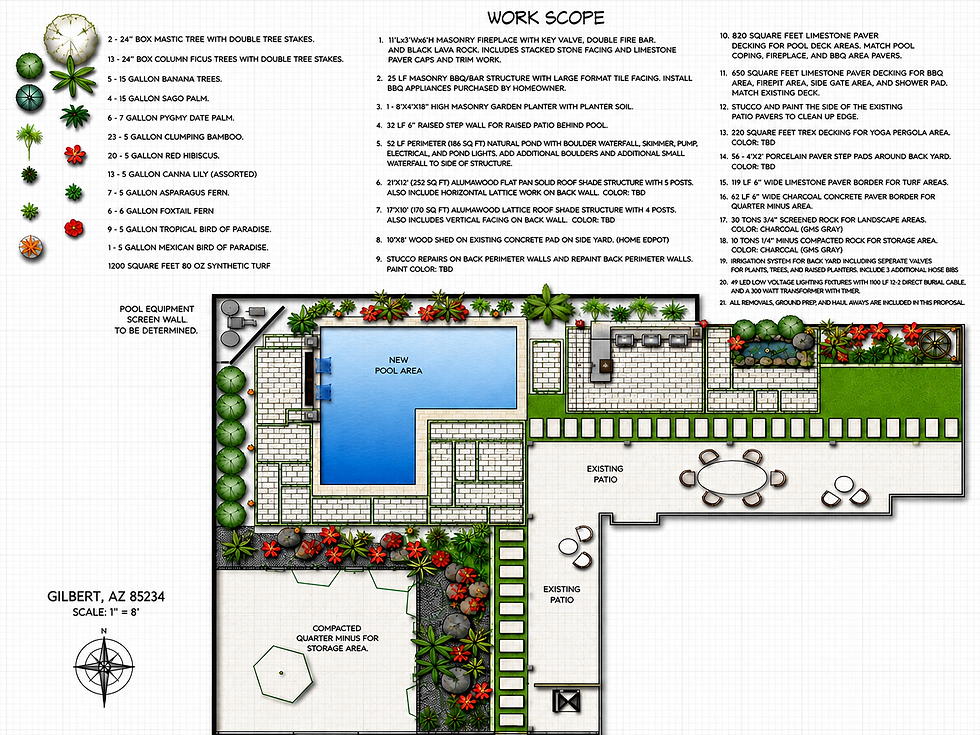
Design has saved more than one of our remodels from a major disaster. I remember one specific Gilbert project a few years back where we were hired by a pool company to install decking, turf, garden boxes and trampolines around the new pool. We were working in conjunction with a couple of other trades when it came to my attention that the footings poured by another contractor were in the wrong location. If we had just proceeded with our portion of the work without verifying the plan, the whole side of the yard would have been off and both of us would have had to remove everything and start over.
Luckily, because we were working off of a very detailed plan, we were able to detect a small mismeasurement before it resulted in a major problem. I've heard plenty of stories from homeowners and other contractors alike who weren't so lucky. If you're still on the fence about whether or not to get a professional design for your outdoor project, I give my honest assessment in Do You Really Need a Landscape Design?
Avoiding Costly Mistakes Starts Before Construction
Nearly every mistake on this list is decided before the first shovel hits the dirt: who you hire, how the yard is laid out for your climate and your family, and what's written into the contract. Those decisions are also the cheapest ones to get right.
Oasis Green has spent 20+ years designing and installing backyards across the East and West Valleys. The projects that turn out best aren't the ones built for a single photo or rough hand drawing. They're the ones homeowners are still using and enjoying years later.
Frequently Asked Questions
How do I check if a landscape contractor is licensed in Arizona?
Search the contractor's name or license number on the Arizona Registrar of Contractors website. Confirm the license is active, its classification covers your project, and the business name matches your contract.
What is the Arizona Residential Contractors' Recovery Fund?
It's a state fund that can reimburse eligible homeowners for losses caused by a licensed residential contractor. Awards are capped at $30,000 per claimant per residence, and you generally have to file an ROC complaint first.
What can I do if an unlicensed contractor took my money?
Report the unlicensed contracting to the ROC and talk with an attorney about civil options. The Recovery Fund generally isn't available when the contractor was never licensed, which is why I always recommend verifying a license before paying anything.
How much should I pay up front for a backyard remodel?
Never the full amount. Payments should follow a schedule tied to phases of completed work, and that schedule should be in your written contract before you pay a deposit.
Can I remodel my backyard in phases?
Yes, and many of my clients do. Plan the whole yard first so gas, water, electrical, and drainage for later phases can be roughed in during the first one.
Do I need a landscape design for a backyard remodel?
For a full or even partial remodel I almost always recommend yes. A design catches layout, drainage, and utility problems on paper, where they're much cheaper to fix.
Thinking About Remodeling Your Backyard?
I'd like to hear what you have in mind. We design and install custom landscapes, outdoor kitchens, ramadas, fireplaces and fire pits, water features, hardscaping, and spas built into the landscape, from a single feature to a complete backyard transformation.
We work in Gilbert, Chandler, Mesa, Queen Creek, San Tan Valley, Ahwatukee, Apache Junction, Scottsdale, Phoenix, and surrounding communities. Schedule a free consultation, and I'll walk your property with you and talk through what's possible for your outdoor space.


